Gravity defines down on Earth
When you stand at the South Pole, down means toward Earth's center and up means away from the planet.

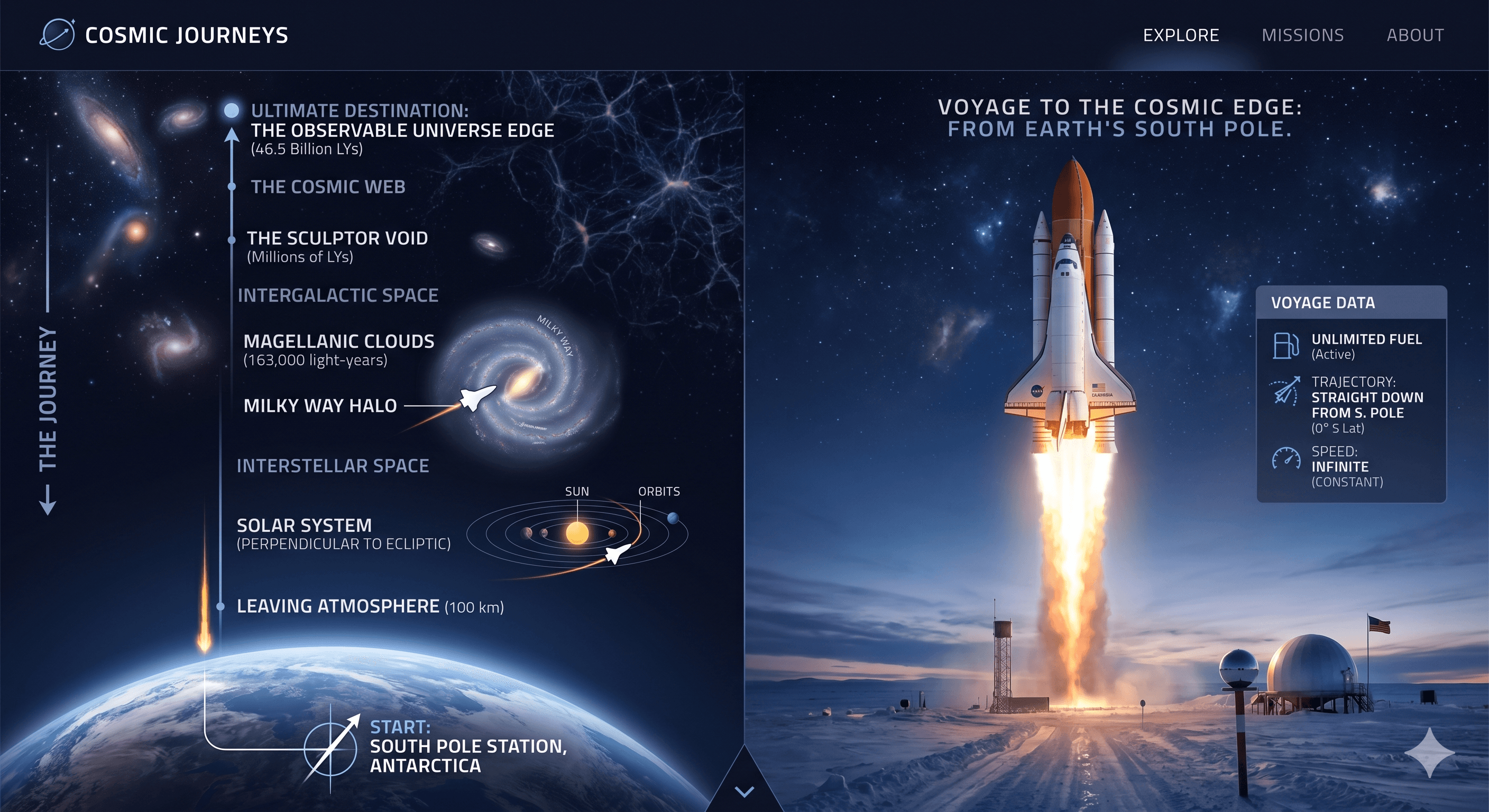
It sounds like a map question, but it turns into a gravity question, then an orbit question, and finally a universe-scale question. The short answer is simple: if you leave Earth from the South Pole side and keep going, down stops meaning down and becomes out.
If you mean literally down while standing at the South Pole, the shuttle would head into the ice and toward Earth's center. That is what gravity means by down.
If you mean straight out from the South Pole side of the planet, into the sky that sits over Antarctica, then the shuttle leaves Earth, misses most of the Solar System, and heads into deep space.
The question feels slippery because our brains mix together three different ideas: the direction gravity pulls, the way globes are drawn, and the way empty space actually works.
When you stand at the South Pole, down means toward Earth's center and up means away from the planet.
Most maps put north at the top and south at the bottom, so it feels natural to imagine the South Pole as the bottom edge of the world.
Once you leave Earth, those map directions stop being cosmic rules. They become local ways of describing orientation.
First you leave the atmosphere. Then you leave Earth orbit. Then you leave the Solar System by heading out of the ecliptic instead of across it. After that, the destinations stop being planets and start becoming stars, dwarf galaxies, dark voids, and the giant web-like structure of the universe.
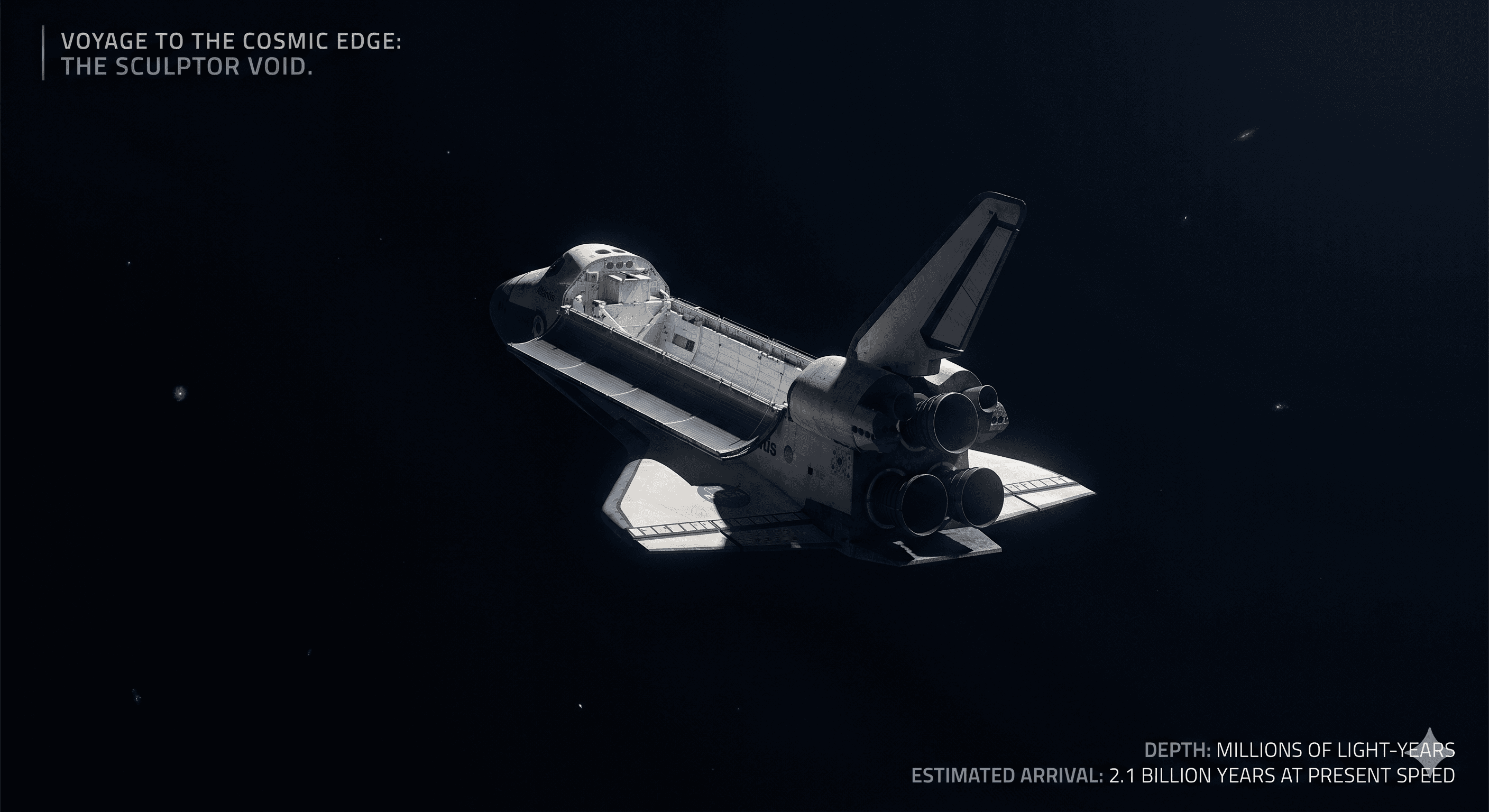
The route out of Earth's southern sky is not a straight shot to a secret planet. It is more like an elevator ride out of local space and into bigger and bigger cosmic structures.
| Waypoint | Approximate distance | What it means |
|---|---|---|
| The South Celestial Pole region | roughly hundreds of light-years | Your line of travel would point toward the southern sky, near Sigma Octantis, a dim star often nicknamed the South Pole Star. |
| The Magellanic Clouds | about 160,000 to 200,000 light-years | These dwarf companion galaxies to the Milky Way sit in the southern sky and become part of the first truly galactic-scale scenery on the route. |
| The Sculptor Void | millions of light-years | Past the nearby satellite galaxies you start entering emptier regions where galaxies are sparse and darkness becomes the main landscape. |
| The cosmic web | hundreds of millions to billions of light-years | Eventually the emptiness gives way to new galaxy filaments, clusters, and structures that are not part of our local galactic neighborhood. |
| The edge of the observable universe | about 46.5 billion light-years in one direction | This is not a wall. It is the limit of how far light has had time to travel to us since the universe began. |