Camera
A crew member records video inside a habitat or through a surface-suit camera.

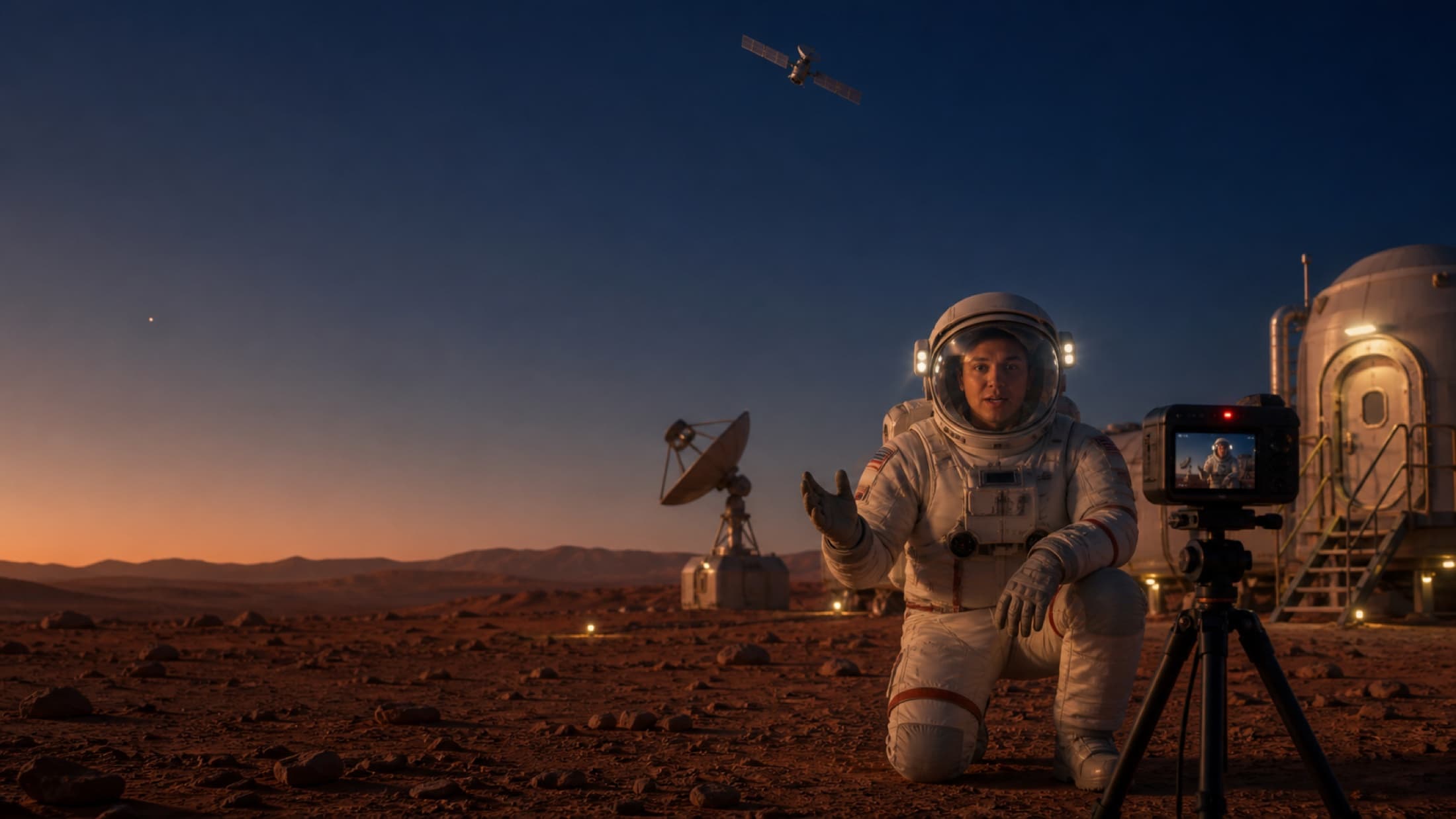
It would look live and continue like a broadcast, but it could never be instant. Every image must cross millions of kilometers at the speed of light.
A host on Mars could speak continuously while viewers on Earth watch continuously. What changes is conversation: even at the closest practical distance, an Earth viewer cannot ask a question and hear the answer for several minutes.
That makes a Mars broadcast closer to a live field report with a very long delay than a video call. The people on Mars would direct the show.
The broadcast can keep playing continuously, but Earth is always watching the past. A reply has to cross the distance twice.
A crew member records video inside a habitat or through a surface-suit camera.
Local antennas send compressed video to a communications tower or nearby relay orbiter.
An orbiter stores the stream, then forwards it toward Earth when geometry and bandwidth allow.
Large antennas on Earth receive the faint radio signal and route the data onto terrestrial networks.
The stream is decoded, buffered, and delivered like online video, only minutes behind Mars.
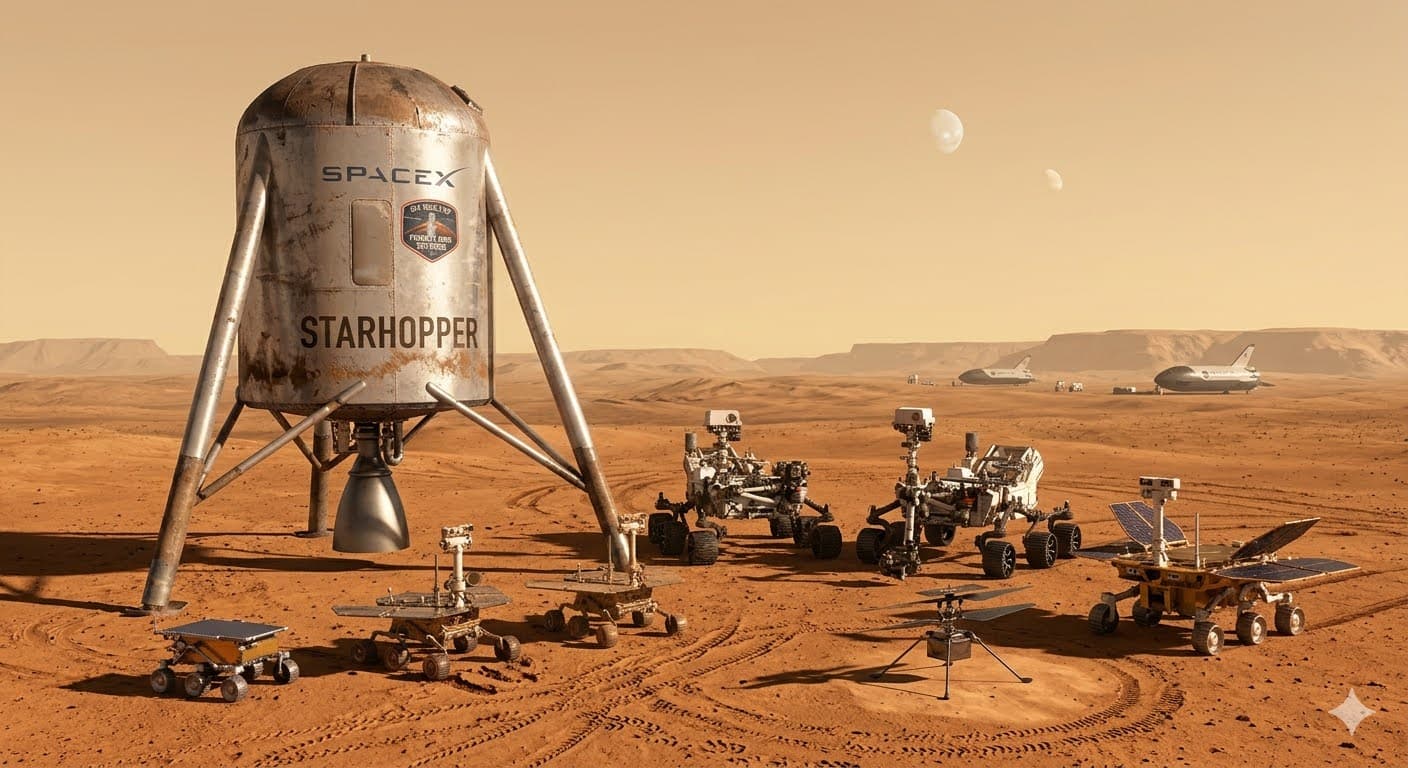
Rovers commonly send data upward to orbiters, which forward it to Earth. NASA says rover-to-orbiter links can reach about 2 megabits per second, but coverage, Earth-facing capacity, and mission schedules make that very different from continuous high-definition video.
A human settlement would need the same basic architecture at a much larger scale: more relays, more bandwidth, more antennas, and a network designed to recover gracefully from interruptions.
Dust, radiation, cold, low power, and limited repair access make ordinary broadcast gear a poor fit.
High-quality video would be compressed aggressively so every useful bit can survive the narrow interplanetary link.
Several orbiters could provide longer coverage windows and avoid depending on one spacecraft passing overhead.
If a link drops, the network keeps the missing pieces and sends them later instead of losing the whole program.
Receiving continuous human-mission video would compete with science and navigation traffic, so Earth needs added capacity.
Mars crews would switch cameras, add captions, and package the program locally because Earth cannot direct them in real time.
For interviews, Earth would send questions ahead. Mars would answer them in its own time.
The remarkable part would not be perfect picture quality. It would be seeing another human world speak for itself, knowing every frame crossed interplanetary space to reach us.