Power, communications, navigation, thermal control, and trajectory corrections during the flight from Earth.
539 kg fueled
Curiosity & Sky Crane
MSL / GALE CRATER / SOL 0Curiosity,
Curiosity,
piece by piece.
Inside the one-ton science rover—and the rocket-powered Sky Crane that became part spacecraft, part landing gear, then flew away forever.
- LANDED MASS
- 899 kg
- SCIENCE INSTRUMENTS
- 10
- SKY CRANE BRIDLE
- 7.5 m
- TOUCHDOWN SPEED
- 0.75 m/s
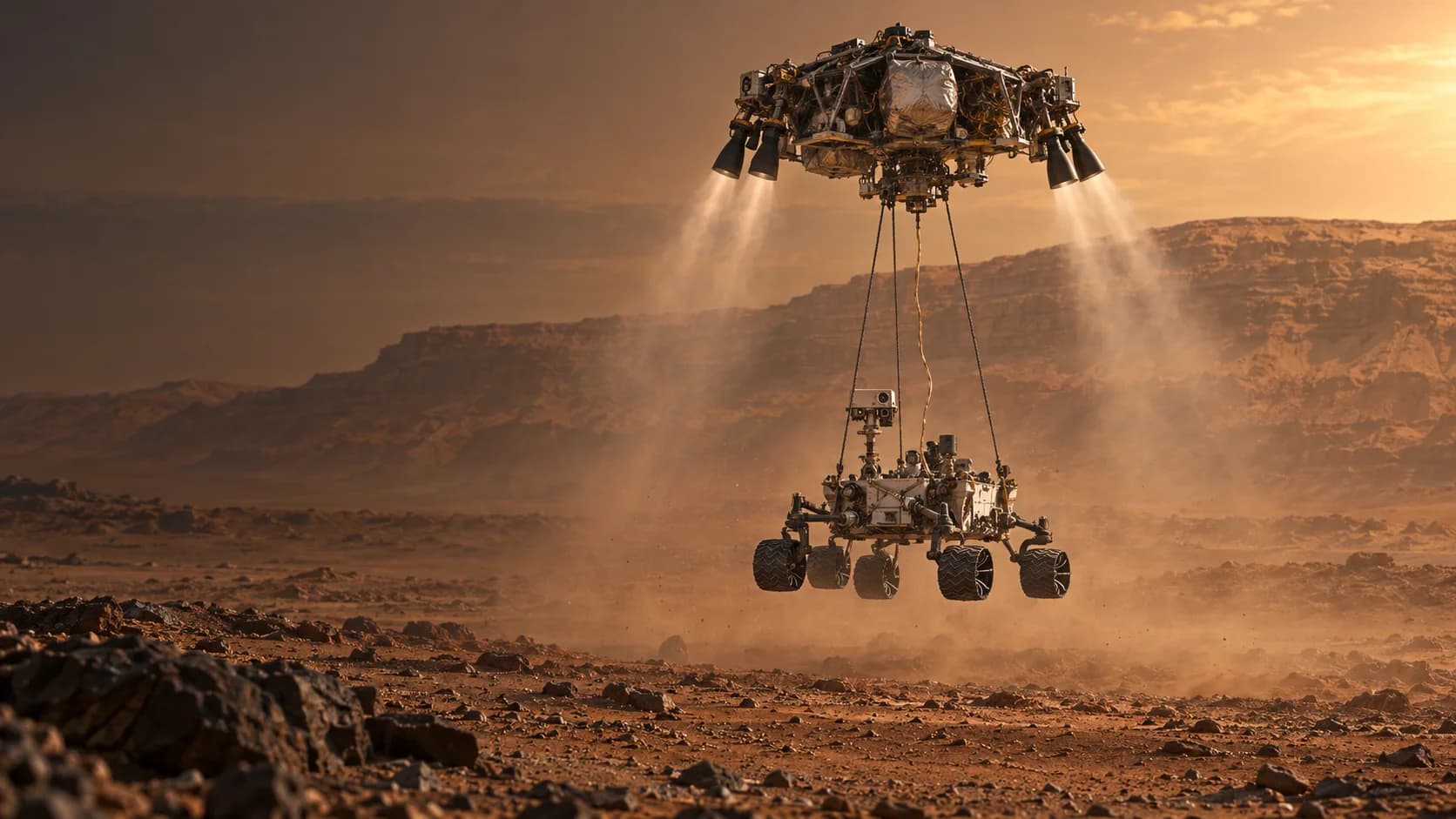
To land Curiosity, engineers briefly turned the rover and its descent stage into one flying machine.
Airbags had worked for smaller Mars rovers, but an 899-kilogram laboratory was too large for that approach. A traditional legged lander would add ramps, structure, and a difficult drive-off sequence.
The Sky Crane inverted the problem. It used Curiosity’s own wheels as landing gear, placed the rover directly on the surface, and kept rocket exhaust farther from the instruments.
01 / FLIGHT ARCHITECTURE
Four machines. One trip to the surface.
Heat shield, backshell, and parachute protect and decelerate the spacecraft through the Martian atmosphere.
4.5 m diameterRadar, computers, hydrazine tanks, and eight engines control the final powered flight above the ground.
390 kg propellantThe mobile laboratory arrives wheels-down, ready to communicate, drive, image, drill, and analyze.
899 kg landed02 / WATCH THE MECHANISM
The final handoff
The descent stage holds a steady vertical speed while a winch pays out three load-bearing bridles. The rover’s wheels unfold, the suspension becomes the landing gear, and touchdown is detected through a change in engine demand.
After the rover confirms weight-on-wheels, pyrotechnic cutters sever the bridles and electrical umbilical. The stage immediately pitches away and spends its remaining propellant reaching a safe crash site.
03 / ENTRY, DESCENT & LANDING
From 5.9 kilometers per second to wheels stopped.
Atmospheric entry
The aeroshell meets Mars at about 5.9 km/s, using drag and its heat shield to shed most of the spacecraft’s energy.
Supersonic parachute
A 21.5-meter disk-gap-band parachute deploys while the vehicle is still moving faster than sound.
Radar lock
The heat shield drops away, exposing a Ka-band radar that measures altitude and velocity above the landing site.
Powered descent
The backshell separates. Eight throttleable engines slow the descent stage and steer it toward a safe touchdown point.
Sky Crane
At roughly 18.6 meters, Curiosity descends on three bridles while its wheels unfold into landing position.
Touchdown & flyaway
The wheels take the rover’s weight. Cables are cut, and the descent stage climbs away to crash at a safe distance.
04 / ROVER ANATOMY
A field laboratory built to move.
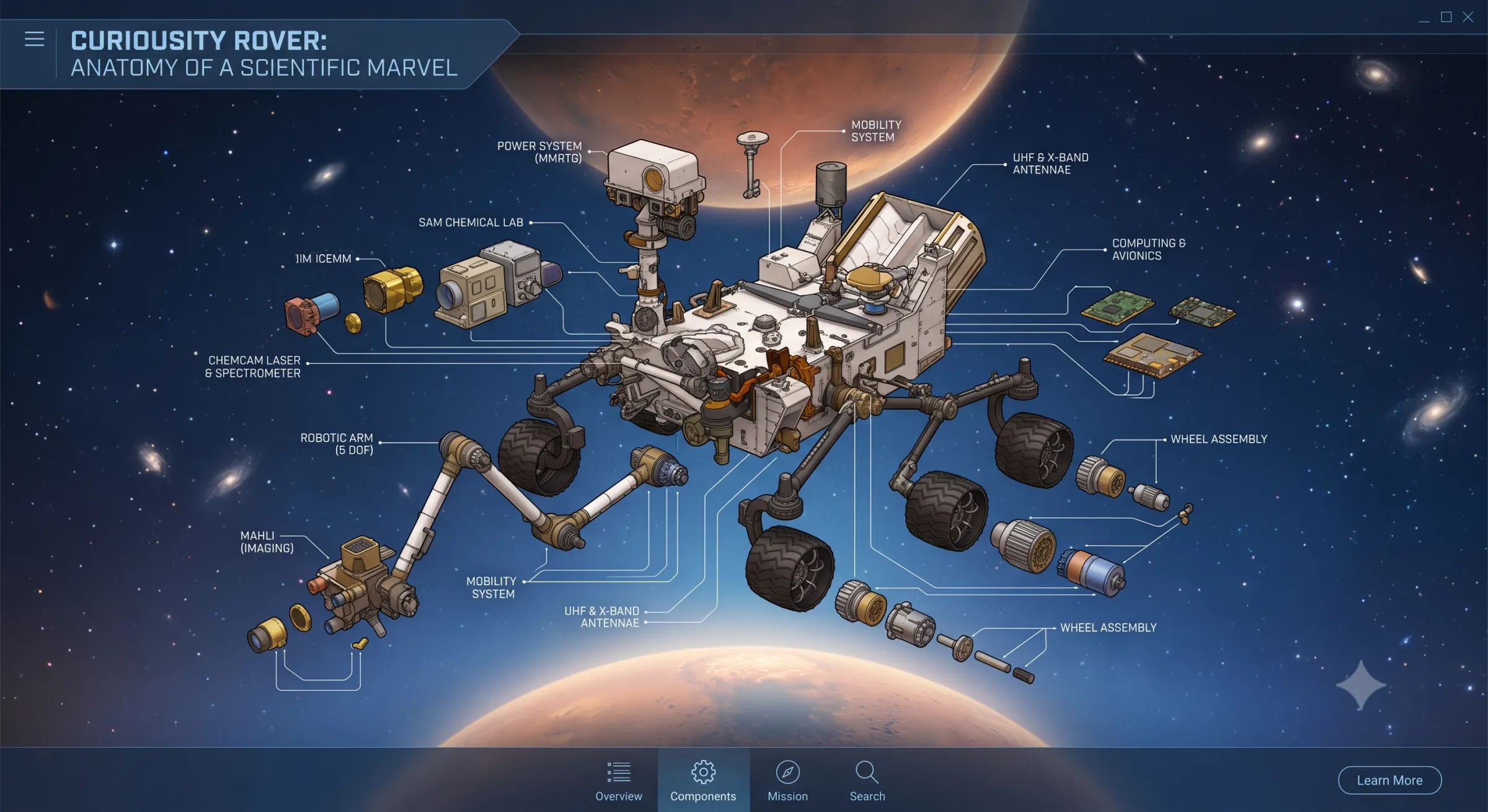
Curiosity combines the mobility of a rover, the reach of a robotic arm, and laboratory instruments that would normally fill a room.
Warm Electronics Box
Curiosity’s structural core protects computers, power distribution, and instruments from Mars’s cold and dust.
Rocker-bogie suspension
Six independently driven wheels and a passive linkage keep the chassis comparatively level over rocks and trenches.
Remote sensing mast
At about 2.1 meters high, the mast carries Mastcam, ChemCam, navigation cameras, and weather sensors.
Five-joint robotic arm
A 2.1-meter arm places a drill, camera, spectrometer, brush, and sample-processing hardware against Martian targets.
MMRTG power
A radioisotope generator supplied about 110 watts at the start of the mission and continues working through day, night, and winter.
Dual flight computers
Two radiation-hardened RAD750 computers provide a primary and backup command system for surface operations.
05 / SCIENCE PAYLOADTen instruments.
Ten instruments.
One central question.
Could ancient Mars have supported microbial life? Curiosity reads the planet from orbit-scale context down to minerals, molecules, radiation, and weather.
Color and stereo imaging
Laser spectroscopy at a distance
Elemental chemistry by X-ray
Hand-lens close-up imaging
Mineral identification by diffraction
Organic compounds and atmospheric gases
Surface radiation environment
Subsurface hydrogen and water clues
Weather and ultraviolet monitoring
Descent imaging during landing
06 / SKY CRANE UNDER THE HOOD
A disposable precision aircraft.
DESCENT
STAGE
STAGE
Four canted pairs throttle to brake, hover, translate, and fly away.
Six antenna beams measure range and velocity relative to the ground.
A powered winch lowers the rover while maintaining data and electrical connections.
Touchdown releases the suspended load; cutters fire and the stage diverts away.
THE DESIGN DECISION
Why not airbags?
Airbags must survive impact while protecting the payload and then settle in a safe orientation. At Curiosity’s scale, their volume, strength, and rebound loads became impractical.
THE PAYOFF
Why wheels-down?
No landing legs. No deployment ramp. No drive-off maneuver. The rover touched Mars already in its surface configuration and began operating from the place it landed.
Go deeper into the engineering.
JPL • MSL Landing Press Kit ↗NASA Science • Curiosity Mission ↗NASA NTRS • Sample Acquisition System ↗NASA NTRS • Ground Contact Model ↗
This field guide synthesizes the supplied technical research with NASA and JPL source material. Values are rounded for readability.
The wildest part worked exactly once—then became the blueprint.
Curiosity landed in Gale Crater on August 6, 2012. The same basic Sky Crane architecture later delivered Perseverance, proving that a daring one-time maneuver could become a repeatable way to place heavy rovers on Mars.
Watch the Landing Again