Starship + Super Heavy
- Lower stage
- One integrated booster
- Booster engines
- 33 Raptors
- Primary separation
- One hot-stage event
- Recovery problem
- One 72-meter booster

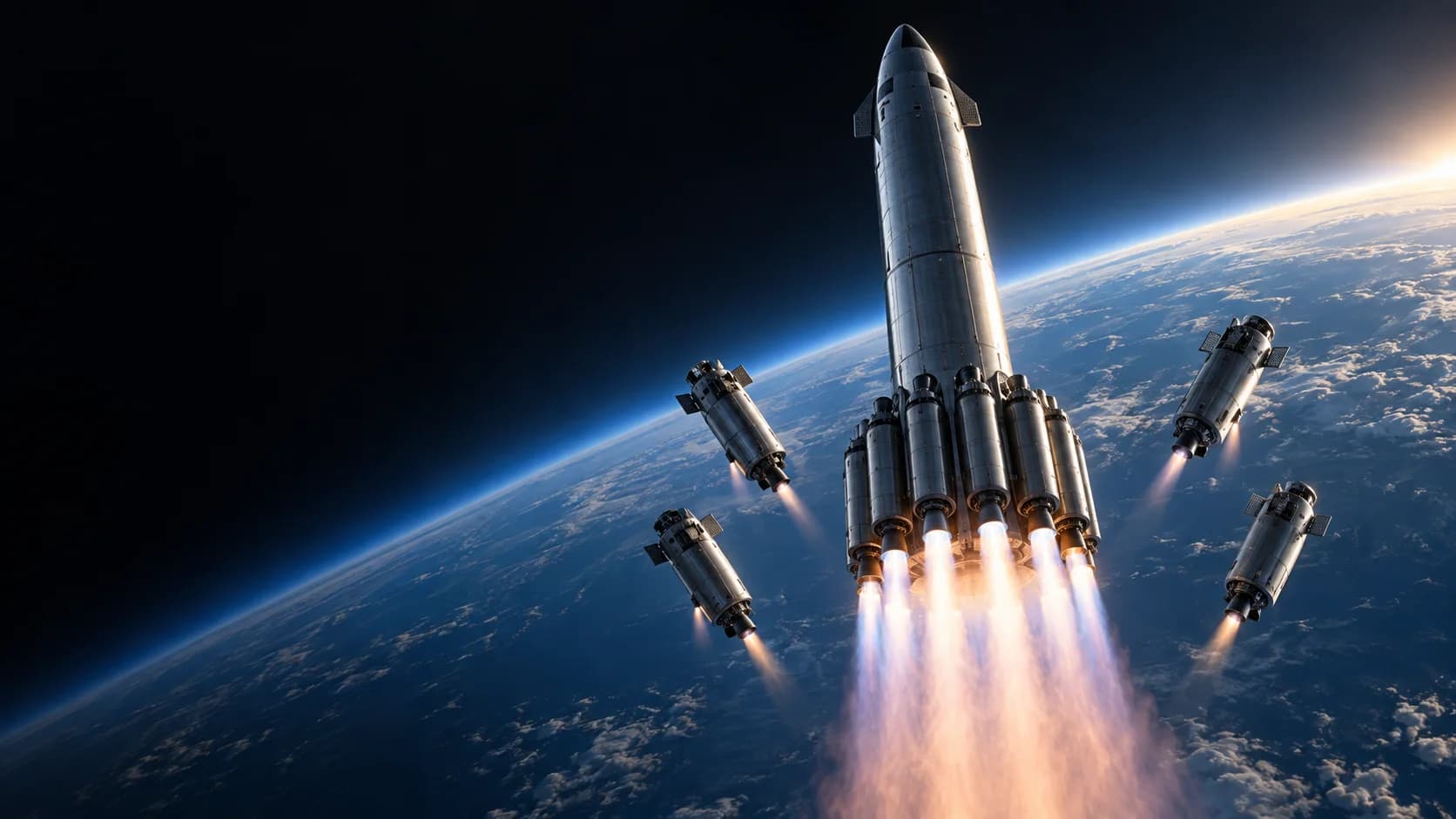
What if a booster were not one giant stage, but a ring of detachable propulsion modules—each able to separate, survive, navigate, and land on its own?
“Starship K-1 Kayfun” is an independent thought experiment created for this site. SpaceX’s real Starship architecture uses a reusable Starship upper stage and a monolithic Super Heavy booster powered by 33 Raptor engines. The 39-pod system below has not been proposed, tested, or endorsed by SpaceX.
Conventional launch vehicles concentrate propellant, structure, engines, and avionics into a small number of large stages. That keeps interfaces manageable, but the entire first stage remains attached until one planned separation event.
The Atomizer concept divides that lower stage into many self-contained propulsion cells. As selected pods empty, they detach symmetrically instead of remaining dead mass. The upper vehicle keeps climbing with fewer engines, less tankage, and a changing mass distribution.
That is the promise. The price is transforming one booster into a coordinated fleet of forty flight computers, forty propulsion systems, and thirty-nine high-energy separation events.
The inspiration is modular fluid machinery: isolated chambers, repeatable interfaces, and serviceable assemblies. In a launch vehicle, every neat mechanical boundary becomes a severe cryogenic, structural, aerodynamic, and software problem.
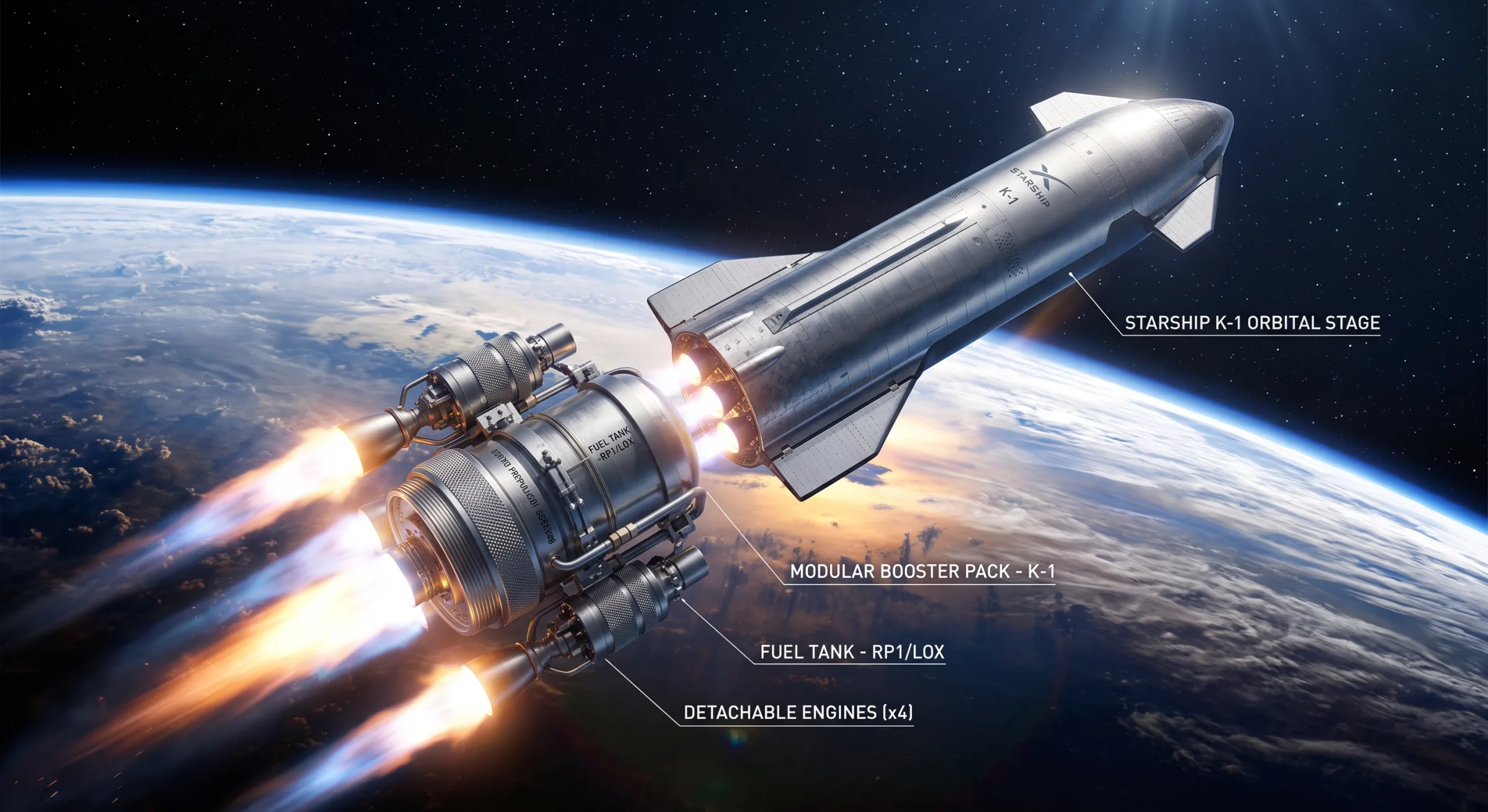
This early four-module visualization establishes the design language. The proposed architecture described here expands the perimeter to 39 conceptual pods.
A dedicated methane-and-oxygen reservoir isolates each pod from the rest of the cluster.
Each module carries a complete propulsion path instead of sharing one booster-wide feed system.
Structural latches and self-closing fluid and data ports must separate cleanly under load.
Guidance, navigation, communications, batteries, and fault logic turn every released pod into a small spacecraft.
A deployable interface cover and local thermal protection shield the vulnerable mating surface during return.
Grid fins, reaction controls, landing legs, and reserve propellant guide an autonomous terminal burn.
The supplied animation follows the concept from clustered flight through pod separation, entry, terminal burns, and distributed landings.
It is a visualization, not a simulated trajectory. A credible design would need six-degree-of-freedom analysis, plume interaction models, debris-clearance envelopes, thermal analysis, and range-safety constraints before a sequence like this could be claimed feasible.
The core and 39 perimeter modules leave the pad as one tightly controlled propulsion cluster.
No separation occurs through peak aerodynamic pressure; throttling protects the modular joints and outer ring.
The earliest depleted group shuts down, seals its interfaces, and receives a clean outward impulse.
Later pairs or rings depart only when guidance can preserve balance, clearance, and acceptable acceleration.
The orbital vehicle completes ascent without hauling the released pods or their empty tanks to full orbital speed.
Each pod follows its own protected entry corridor toward a dedicated landing or catch zone.
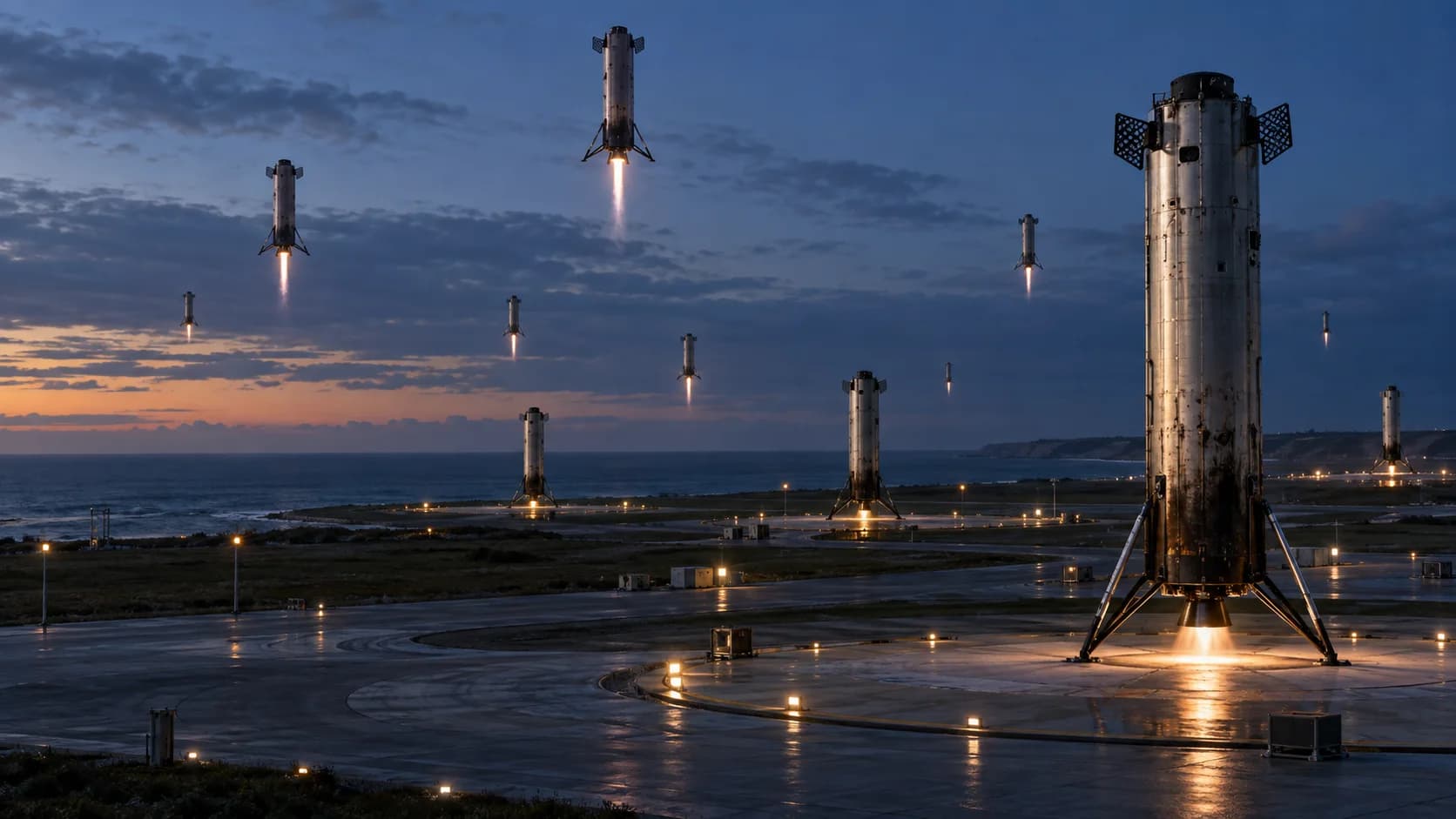
A single returning booster creates one major guidance and range-safety problem. Thirty-nine small vehicles create a distributed air-traffic system: separate corridors, weather decisions, landing pads, telemetry links, reserves, and abort zones.
Discard depleted tankage earlier in ascent.
Every pod duplicates tanks, valves, avionics, thermal protection, controls, and landing hardware.
A failing module might be shut down and released.
One bad separation can strike the core, another pod, or a critical aerodynamic surface.
Swap and service propulsion modules independently.
Thirty-nine flight articles create inspection, certification, spares, and configuration-control work.
Small units could use distributed landing zones.
Dozens of simultaneous hypersonic returns multiply range, weather, telemetry, and airspace demands.
Repeat one standardized module at high volume.
High part count and precision mating surfaces can overwhelm savings from repetition.
The Atomizer concept attacks a real launch-vehicle penalty: carrying empty structure after its useful work is done. But it trades a small number of large, mature interfaces for dozens of tanks, seals, computers, reentry vehicles, and landing events. Until a detailed mass model shows a positive margin, modular staging remains a provocative architecture—not a shortcut around the rocket equation.
Revisit the Pod DesignCurrent Starship and Super Heavy specifications are drawn from SpaceX’s published vehicle overview. K-1 quantities, mechanisms, and flight sequences are independent speculative assumptions for this concept study.
SpaceX • Starship vehicle overview ↗