
Ion Propulsion
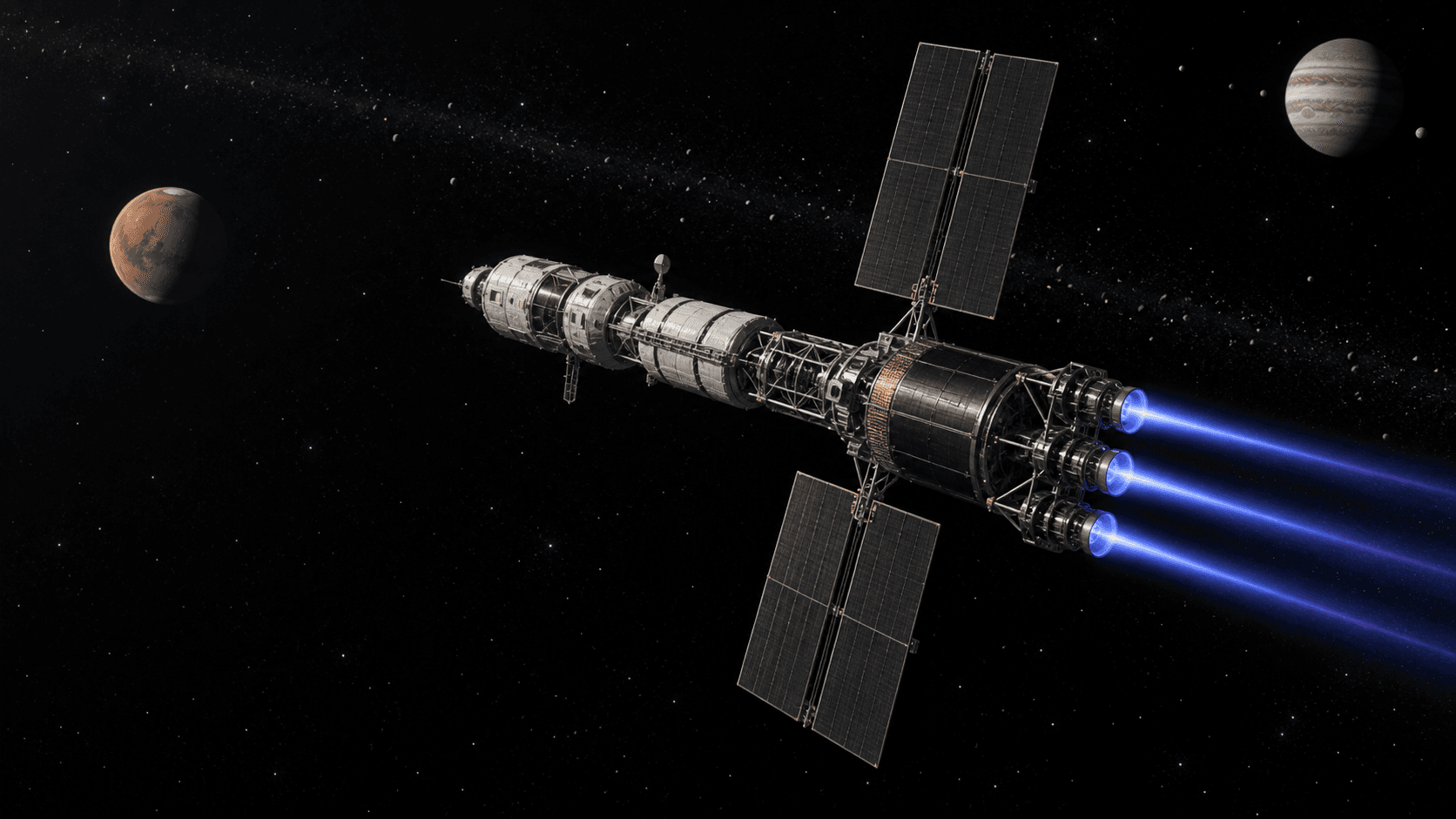
Nuclear-electric mission architecture
Beyond Chemical Rockets: The Electric Path to Deep Space
How ion thrust technology could make human exploration of Mars, Jupiter, and Europa faster, lighter, and more adaptable.
EXHAUST VELOCITYUP TO 50 KM/STHRUST DURATIONMONTHS TO YEARSPRIMARY POWERNUCLEAR ELECTRIC
AI-generated concept illustration • Not a current NASA vehicle01 / THE MISSION EQUATION
Chemical rockets win the first ten minutes. Electric propulsion can win the next hundred million kilometers.
Launch vehicles are unmatched at producing the violent thrust needed to leave Earth. But a deep-space crew vehicle has a different job: move a large, protected habitat for months, make meaningful course changes, and still arrive with enough propulsion to slow down.
That is where chemical propulsion runs into mass and time. Every extra kilogram of propellant demands still more propellant to accelerate it—the compounding penalty described by the rocket equation.
Interactive mission comparison
Trade a mountain of fuel for a thread of thrust.
Ion engines push gently, but they use propellant with extraordinary efficiency. Move the payload slider to see why that difference compounds as a human spacecraft gets heavier.
Destination
Mars mission model225 million km average
ChemicalShort, forceful burn
Illustrative propellant load650 t
- Transit
- 6–9 months
- Exhaust speed
- ~4.5 km/s
- Trajectory
- Burn, then coast
Nuclear-electricLow thrust, sustained
Illustrative propellant load70 t
- Transit
- 3–4 months (concept)
- Exhaust speed
- Up to ~50 km/s
- Trajectory
- Accelerate, turn, brake
Illustrative scaling based on the efficiency relationship in this concept, not a flight-ready mission design. Real mass ratios and travel times depend on reactor power, thrust, shielding, trajectory, and arrival strategy.
02 / Inside the thruster
No combustion. Just charged atoms moving very, very fast.
A propellant such as xenon or argon enters the thruster, becomes ionized, and accelerates through an electric field. A neutralizer adds electrons back to the outgoing beam so the spacecraft does not build up an electric charge.
01Gas feed
Xenon or argon enters in a controlled flow.
02Ionize
Electrons strip charge from the propellant atoms.
03Accelerate
High-voltage grids drive ions out at extreme speed.
04Neutralize
Electrons rejoin the exhaust to balance the craft.
Chemical exhaust~4.5km/s
~10× exhaust velocity
Ion exhaust50km/s
The power behind the blue plume
Nuclear Electric Propulsion keeps working when the Sun fades.
A compact reactor produces heat, power conversion turns that heat into electricity, and the electricity drives a cluster of thrusters. The reactor does not heat the propellant directly; it powers the electric fields that accelerate it.
REACTORPOWER CONVERSIONTHRUSTER ARRAYCONTINUOUS DELTA-V
03 / Mission profile
Humans to Mars
~3–4 monthsillustrative nuclear-electric conceptA faster transfer could roughly halve a conventional six-to-nine-month trip. That matters because time in deep space means cumulative exposure to galactic cosmic radiation, isolation, and microgravity.
MetricChemicalNuclear-ion
Transit~6–9 months~3–4 months*
PropellantVery high massFar lower mass
TrajectoryNarrow coast arcOngoing correction
04 / Mars to the Jovian system
At Jupiter, arrival is as hard as departure.
Reaching the neighborhood is only half the problem. A heavy crewed vessel must shed enormous velocity to enter orbit, then move between moons while minimizing time in Jupiter’s harshest radiation zones.
Trajectory lab
Two very different ways to cross space
Earth
Mars
Jupiter / Europa
Chemical: coast arcIon: continuous thrust
A powered trajectory can keep changing its shape after Earth departure.
Cross the belt
Steady, low thrust continues through the outer Solar System without carrying a chemical stage for every major maneuver.
Brake for Jupiter
The ship turns its thrust vector and gradually reduces velocity over weeks rather than demanding one enormous capture burn.
Work the moons
Efficient transfers between Callisto, Ganymede, and Europa could keep the main crew habitat farther from the worst radiation whenever possible.
05 / The gap between concept and crew
The physics works. The scale does not—yet.
Electric propulsion already flies on satellites and robotic missions. Turning it into a human deep-space transportation system requires several breakthroughs to mature together.
Scale the thrust
Today’s flight-proven ion engines are built for robotic spacecraft. Human missions would need arrays of high-power ion or Hall-effect thrusters operating together at megawatt scale.
Shrink the reactor
Beyond Mars, sunlight becomes a weak power source. A crewed transport needs a lightweight reactor delivering roughly 1–10 megawatts of electricity, plus conversion and fault-tolerant distribution hardware.
Survive years of operation
High-energy plasma slowly erodes thruster surfaces. Grids, channels, cathodes, power electronics, and propellant feeds must run reliably for thousands of hours.
Reject the heat
A reactor and its power electronics create waste heat. In vacuum, enormous radiators must shed it without becoming too heavy or vulnerable for the mission.
Use chemistry to leave Earth. Use electricity to cross the dark.
The practical path is not chemical versus ion propulsion. It is a staged system that gives each technology the job it does best—high thrust near planets, extreme efficiency between them.
Revisit the Mission Model